What Is an EOR?
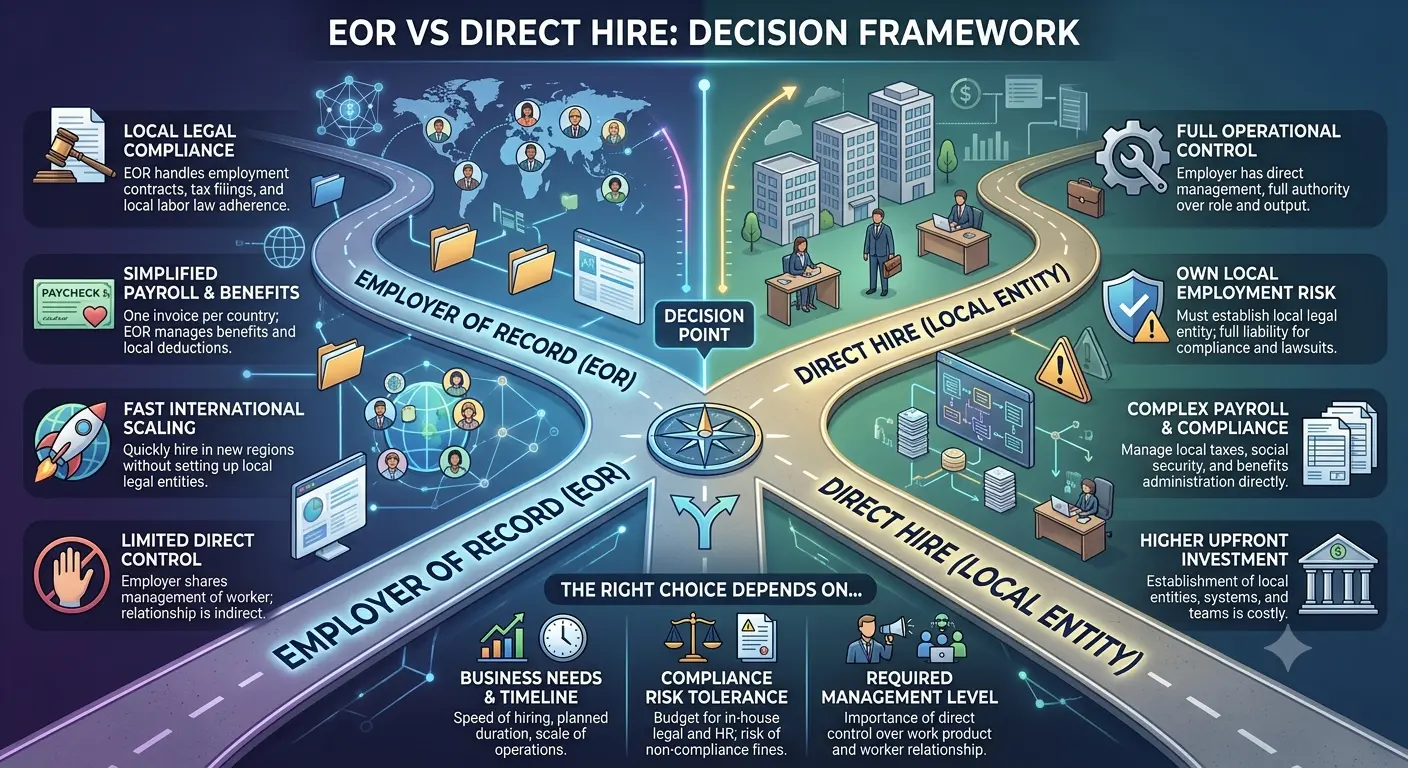
An Employer of Record (EOR) is a third party that legally employs workers on behalf of a client company. The EOR handles payroll, tax withholding, employment contracts, and statutory benefits in the worker's country — while the client directs the day-to-day work.
For cross-border hiring, the EOR model solves a basic problem: a foreign company usually can't employ workers in another country without establishing a local legal entity, which is expensive, slow, and often unnecessary for small or project-based teams.
In the Philippine context, a foreign employer who wants to hire and pay a Filipino worker who stays domiciled in the Philippines — without deploying them abroad — would typically need an EOR arrangement with a licensed local entity. Deploying a worker abroad is a separate track, governed by the DMW.
Direct Hire: The Risks
Direct hire — a foreign employer contracting a worker without a licensed Philippine intermediary — is permitted only in limited circumstances and carries real risk if done outside the approved framework:
Misclassification — if a worker is labelled an independent contractor but the arrangement looks like employment (fixed hours, employer direction, exclusivity), authorities may reclassify it, triggering back contributions and penalties.
Deployment exposure — deploying a worker abroad through a non-licensed channel is a criminal offence under Philippine law. Both the worker and the foreign employer can face serious legal jeopardy.
Insurance gaps — licensed deployments include mandatory worker insurance. Arrangements that bypass the framework leave workers unprotected and employers exposed to liability.
Side-by-Side Comparison
Setup time: EOR (around 1–2 weeks) vs. direct hire with a local entity (commonly several months)
Cost: EOR (a service fee on payroll) vs. direct hire (lower per-worker cost, but significant entity setup and maintenance costs)
Compliance risk: EOR (managed by the provider) vs. direct hire (borne by the employer)
Flexibility: EOR (easy to scale up or down) vs. direct hire (exit is more complex, governed by local law)
Speed to hire: EOR (fast, no entity required) vs. direct hire (slower, entity registration adds time)
Suitable team size: EOR (small to mid-sized teams) vs. direct-hire entity (larger, permanent operations where setup cost is justified)
When to Choose EOR
An EOR tends to make sense when:
You're entering a new market and want to test demand before committing to a local entity — EOR gives you compliance without the overhead.
You need to hire quickly — onboarding through an EOR is typically far faster than registering an entity.
Your in-country team is small — the cost of EOR is usually justified by what you save on accountants, local directors, registered office, and entity maintenance.
Your engagement is project-based or time-limited — EOR relationships are straightforward to wind down; dissolving an entity is not.
You're hiring remote workers who stay in their home country — the classic EOR use case, where the EOR is the legal employer and you direct the work remotely.
When Direct Hire Works
Direct hire with a properly registered entity makes sense when:
Your operation is permanent and large enough that the fixed costs of an entity are justified, and the per-worker savings over EOR become meaningful.
You need full control over the employment relationship — bespoke benefits, equity participation, custom terms — that standardised EOR contracts don't offer.
Local regulation requires an entity for your industry, regardless of team size.
You're an established multinational with existing regional entities and the compliance infrastructure to manage local employment law directly.
Philore operates an EOR/COR service for employers hiring Filipino and Indonesian talent, and provides compliance advisory for those weighing a direct-hire structure. A consultation can help map which model fits your situation.
Ready to hire?
Get a staffing plan built for your timeline.
Tell us your role, volume, and destination — we'll respond within 24 hours.