2026 Overview
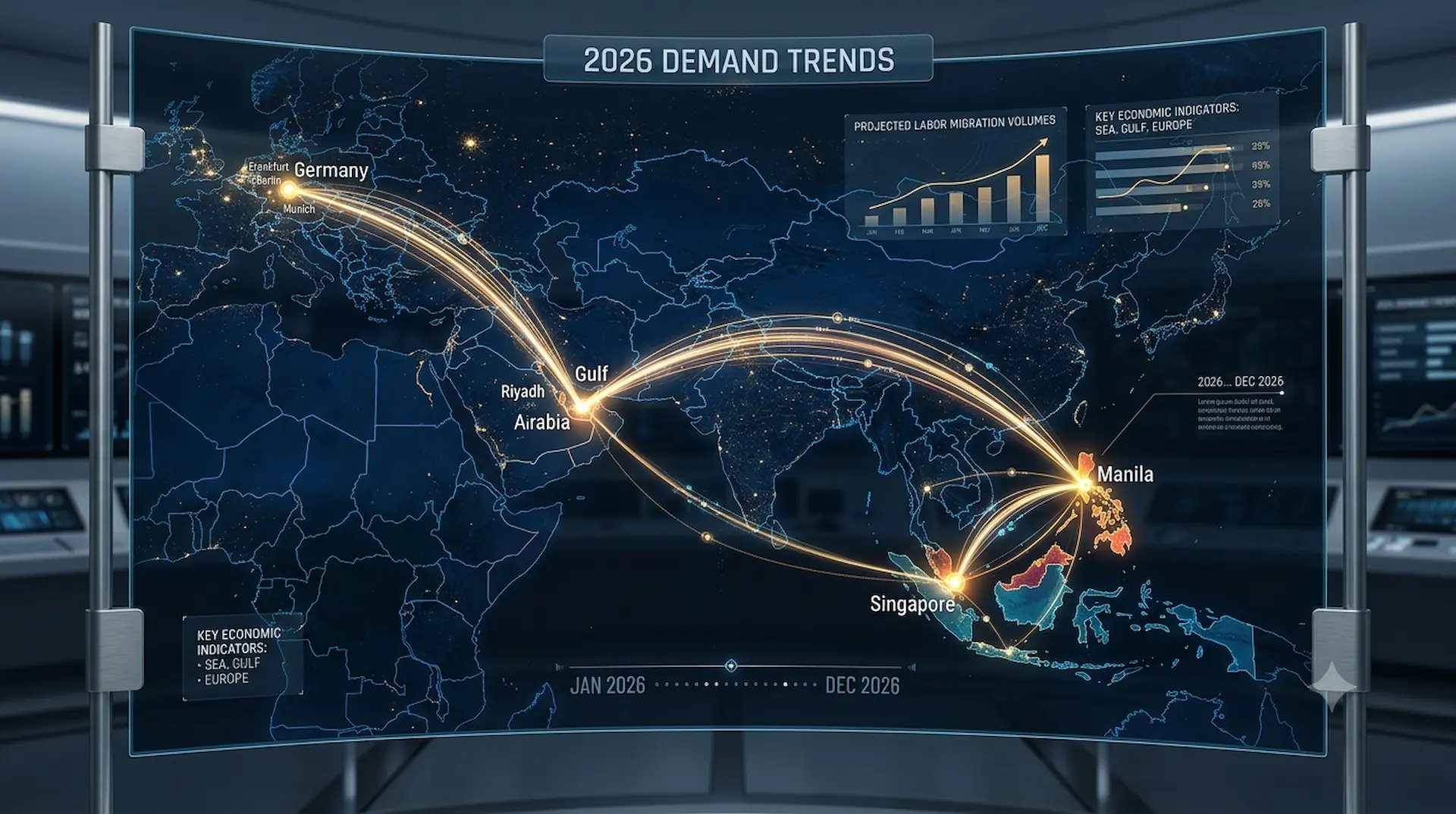
Overseas employment from the Philippines has continued its post-pandemic recovery, with demand concentrated in three broad areas: the Gulf Cooperation Council (GCC), where construction, hospitality, and services remain the largest employers of Filipino workers; Singapore, where domestic and care work demand is structurally high; and an emerging corridor in Central Europe, where Germany's Skilled Immigration Act has opened a pathway for nurses and skilled professionals.
We've avoided publishing precise national projections here, because the figures that circulate are often estimates layered on estimates. What we can say with confidence is directional: healthcare and care work are the fastest-growing categories, and demand is consistently outpacing the supply of fully documented, deployment-ready workers.
Where the Demand Is
Saudi Arabia and the UAE remain the largest destination markets by volume, driven by construction, hospitality, and services. The UAE in particular has seen sustained demand tied to large infrastructure and tourism projects.
Singapore stays a high-demand market for domestic workers, healthcare, and F&B, with placement timelines lengthening as supply tightens.
Qatar and the rest of the GCC remain steady, with energy-sector work partly offsetting the wind-down of large one-off construction programmes.
Germany is the corridor to watch. It is more document-intensive than the GCC — language certification and credential recognition add months — but it offers some of the highest earning potential available to licensed Filipino professionals. Canada and the UK remain smaller but high-value markets for nurses, engineers, and IT workers, where salaries sit well above GCC rates.
Demand by Sector
Healthcare is the clearest growth story. The World Health Organization has repeatedly flagged a global shortage of nurses running into the millions this decade, and that gap is pulling demand for Filipino nurses, caregivers, and allied health professionals across Singapore, Germany, the UK, and beyond.
Hospitality and F&B demand has recovered strongly in the UAE and Singapore after pandemic-era attrition. Employers are increasingly willing to pay for pre-screened, trained staff rather than manage high-volume direct recruitment themselves.
Construction and engineering demand is stable across Saudi Arabia and Qatar and accelerating in the UAE, where infrastructure and tourism projects are generating demand for skilled trades, project managers, and safety officers.
Indicative Salary Ranges
The figures below are indicative monthly ranges, not guarantees — actual offers vary by employer, experience, and contract terms, and currency rates move. Treat them as a planning reference, not a benchmark:
Domestic Worker (Singapore): broadly SGD 700–900
Caregiver (UAE): broadly AED 2,200–3,000
Registered Nurse (Germany): broadly EUR 2,800–3,500
Hotel / F&B Staff (Qatar): broadly QAR 1,800–2,500
Construction Tradesperson (UAE): broadly AED 2,500–4,000
The Germany corridor sits at the top of the range for comparable skill levels, which is part of why it attracts licensed professionals despite the longer, more demanding documentation process.
What to Watch
The near-term picture is one of demand outpacing the supply of documented, deployment-ready workers — particularly in healthcare, domestic work, and skilled trades. Agencies with real pre-screening depth and in-house compliance are best placed when employers prioritise reliability over the lowest headline price.
The main variable is policy. Visa reforms in the GCC, quota changes, and Germany's language and recognition requirements can each slow a corridor with little notice. Tracking regulatory change in real time, rather than reacting to it, is the difference between a placement that lands on time and one that stalls in processing.
We update this view periodically. If you'd like it in your inbox, the Insights newsletter is the place to subscribe.
Ready to hire?
Get a staffing plan built for your timeline.
Tell us your role, volume, and destination — we'll respond within 24 hours.